
Ichimonji no Kamae
一文字の構え
“One line position”
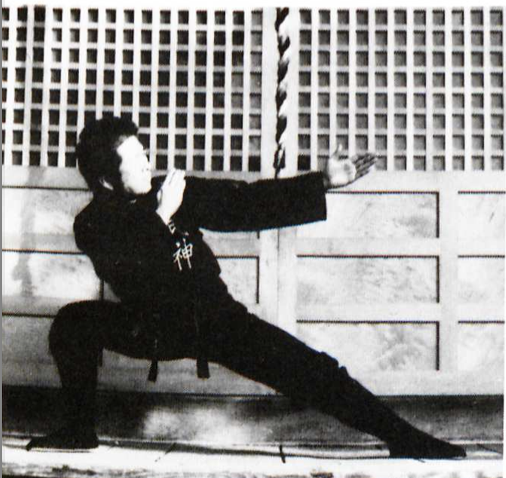
Photo: Masaaki Hatsumi, Togakure, 1983, p. 47
Level: Kyū
Source: TCJ
“Masaaki Hatsumi, TCJ, 1987: (イ) 相手心の臓遠当の事 (ロ)左右の構え 三段の構え上段中段下段とす 上段とは直立、中段とは(イ)の如く、下段とは左又は右の膝を地上つける事により変化潜り型の一助とする。 (ハ)大変術 (ニ)悟心の動作を行う (ホ)基本八法 (ヘ)捕手基本型変化 骨指基本型変化。
Translit.: (I) aite shin no zō tōate no koto (Ro) sayū no kamae san-dan no kamae jōdan chūdan gedan to su jōdan to wa chokuritsu, chūdan to wa (I) nogotoku, gedan to wa hidari matawa migi no hiza o chijō tsukeru koto ni yori henka moguri-gata no ichijo to suru. (Ha) taihen-jutsu (Ni) Goshin no dōsa o okonau (Ho) kihon happō (E) torite kihon-gata henka , kosshi kihon-gata henka.”
Translation by Fluffy Tail: [The internal feeling] is to hit [and destroy] the heart of the opponent from a distance. [There exist] left and right variations of this kamae, and three levels, high, middle and low. The upper level is standing straight, the middle one as is on the picture (1987), the low one [on the left side] is when the right knee is placed on the ground. This is used as helping in the techniques of mogurigata, i.e. attack from below, lit. "diving under”. [Used in] the art of changing body position, taihenjutsu, in making the action of “goshin”, [used in] Kihon Happō, [used in] variations of the armlocks and [in] variations of basic striking forms.
Commentary:
Ichimonji as displayed by Masaaki Hatsumi above is in Togakure style: the body weight is shifted to the back leg. Exists under various names (Ichi in Togakure, Seigan in some other schools) in practically all schools. The position varies according to how down one goes and what is the weight distribution on the front and back legs.
Ichimonji in Gyokko-Ryū style: it is shorter than Togakure, the weight is distributed almost equally on both legs.
Tipps from the Masters :
Carsten Kühn, Kotō Ryū, p. 23, to summarize: the two separate kamaes of Kotō Ryū, i.e. Migi Seigan no Kamae and Hidari Seigan no Kamae are just two forms of Ichimonji with respectively right hand forwards and left hand forwards.
Carsten Kühn, Ten Ryaku no Maki, p. 59, to summarize: it is a position to take distance from the opponent upon the attack.
Carsten Kühn, Togakure Ryū, p. 23: “Die Stellung ist sehr tief, mit weit auseinander gespreiyten Beinen. Beide Fersen stehen genau auf einer Linie (Ichi). Der Körper ist leicht nach hinten gelehnt. Die vordere Hand ist ausgestreckt und zeigt auf Ukes Gesicht. Die hintere Hand wird im Bereich der vorderen Schulter, mit der Handfläche zum Hals, gehalten. Beide Hände in Shutō Ken. Der Grund fierfür leitet sich aus der Tatsache ab, dass wenn Shukō getragen werden, diese nicht so leicht zu erkennen sind. Die Stellung wird auch als Ichimonji no Kamae bezeichnet.“
Carsten Kühn, Gyokko Ryū, p. 19: “Im Gegensaty yur gleichnamigem Körperhaltung in anderen Bujinkan Schulen ist die Ichimonji no Kamae der Gyokko Ryū recht hoch. Das Körpergewicht ist zu gleichen Teilen auf beide Beine verteilt und die Wirbelsäule immer senkrecht. <der vordere Fuss und die vordere offene Hand zeigen zum Gegner, die hintere Faust mit dem aufgestellten Daumen (Boshi Ken) ruht auf dem vorderen Unterarm dicht an der Ellenbeuge.“