
Hōko no Kamae
抱圍の構え
“The embracing position”
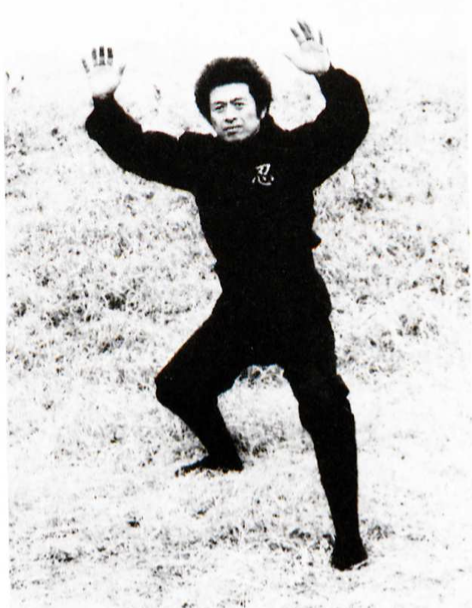
Photo: Masaaki Hatsumi, Togakure, 1983, p. 47
Level: Kyū
Source: TCJ
“Masaaki Hatsumi, TCJ, 1987: (イ) 六法の構え有り(ロ)十八型の構え (ハ)大変術 持に横歩き大変を加える。蟹行きと伝う。(ニ)悟心の動作 両足を蹴り込み練習のこと。(ホ)基本八法 (ヘ)捕手基本型変化 骨指基本型変化。
Translit.: (I) roppō no kamae ari (Ro) jū hachi-gata no kamae (Ha) taihen-jutsu toki ni yoko aruki taihen o kuwaeru. Kani iki to tsutau. (Ni) Goshin no dōsa ryōashi o keri komi renshū no koto. (Ho) kihon happō (E) torite kihon-gata henka, kosshi kihon-gata henka.”
Translation by Fluffy Tail: There are 6 forms of this kamae. [in relation to low, middle and high] it is [thus] a kamae having 18 forms. [Used in] taihenjutsu, i.e. the art of changing body position. To it is to be added the yoko aruki as a form of body change [in application of taihenjutsu]. It is [also] called "walking like a crab”, in making the action of “goshin”. Practice kicking with both feet. [It used in] kihon happō, [used in] variations of the armlocks and [in] variations of basic striking forms.
Commentary:
[TCJ, 1983: a similar posture is called 抱囲, “hōī”, “the siege position”, p. 46, pic. 6]
Occurs in Kotō Ryū.
Tipps from the Masters :
Carsten Kühn, Ten Ryaku no Maki, p. 62, Kotō Ryū, p. 22: “The left leg is standing slightly forward, the hips are lowered. We are holding our hands like open paws at head height or even higher. This is more of a circling, rather offensive position. It corresponds to a position before taking a leap with both hands and both feet.“