
Hichō no Kamae 飛鳥の構え
“The position of a flying bird”
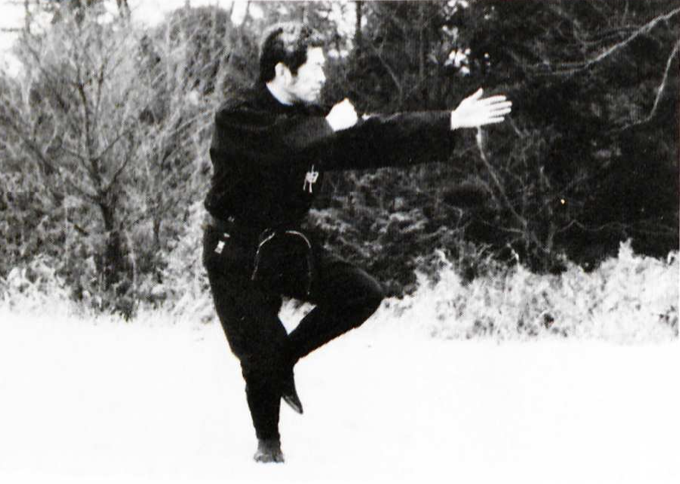
Photo: Masaaki Hatsumi, Togakure, 1983, p. 47
Level: Kyū
Source: TCJ
“Masaaki Hatsumi, TCJ, 1987: (イ) 左右の構え。(ロ)相手の技を殺す。 練習の事。 相手の甲を踏み砕く練習。我が前方の足にて追い打ち 我が手拳にて甲を打ち砕く 相手の足捕りの練習をする。 (ハ)大変術 (ニ)悟心の動作を行う (ホ)基本八法 (ヘ)捕手基本型変化 骨指基本型変化。
Translit.: (I) sayū no kamae. (Ro) Aite no waza o korosu. Renshū no koto. Aite no kō o fumi kudaku renshū. Waga zenpō no ashi nite oiuchi waga te ken nite kō o uchi kudaku aite no ashi tori no renshū o suru. (Ha) taihen-jutsu (Ni) Goshin no dōsa o okonau (Ho) kihon happō (E) torite kihon-gata henka, kosshi kihon-gata henka.”
Translation: Left and right position. [The intent is] to destroy the technique of the opponent. Must be practiced to destroy/hit the instep of the opponent. I kick with [my] forward facing leg, and I hit the instep of the opponent with my arm/fist in order to break it. One should [also] practice catching the opponent's foot. [Used in] taihenjutsu, i.e. art of changing body position, in making the action of “goshin”. [Used in] Kihon Happō, [used in] variations of the armlocks and [in] variations of basic striking forms.
Commentary:
[TCJ, 1983, p. 47, pic. 9]
This position can be found in Gyokko Ryū, Kukishinden Ryū has a variety done with yoroi, it is called Katate Hicho no Kamae. (Separate page.)
Tipps from the Masters :
Carsten Kühn, Gyokko Ryū, p. 19 : “Die Körperhaltung ähnelt einem Kranich, welcher auf einer Bein stehend ruht. Vom Gefühl her sollen wir uns eher wie ein vom Boden startender Vogel fühlen, der bereits ein Bein erhoben hat und gleich seine Flügel ausbreitet. Es ist keine Stellung, in der wir lange verharren, sondern eigentlich nur ein Übergang von einer defensiven in eine offensive Position und umgekehrt. Aber auch der Ansatz zu einem Tritt, wenn wir das Knie hochziehen und der Fuss noch das Knie das Standbeins berührt. Die Haltung des Oberkörpers ist dieselbe wie in der Ichimonji no Kamae.“