
Fudō Ken 不動拳
“The immovable fist”
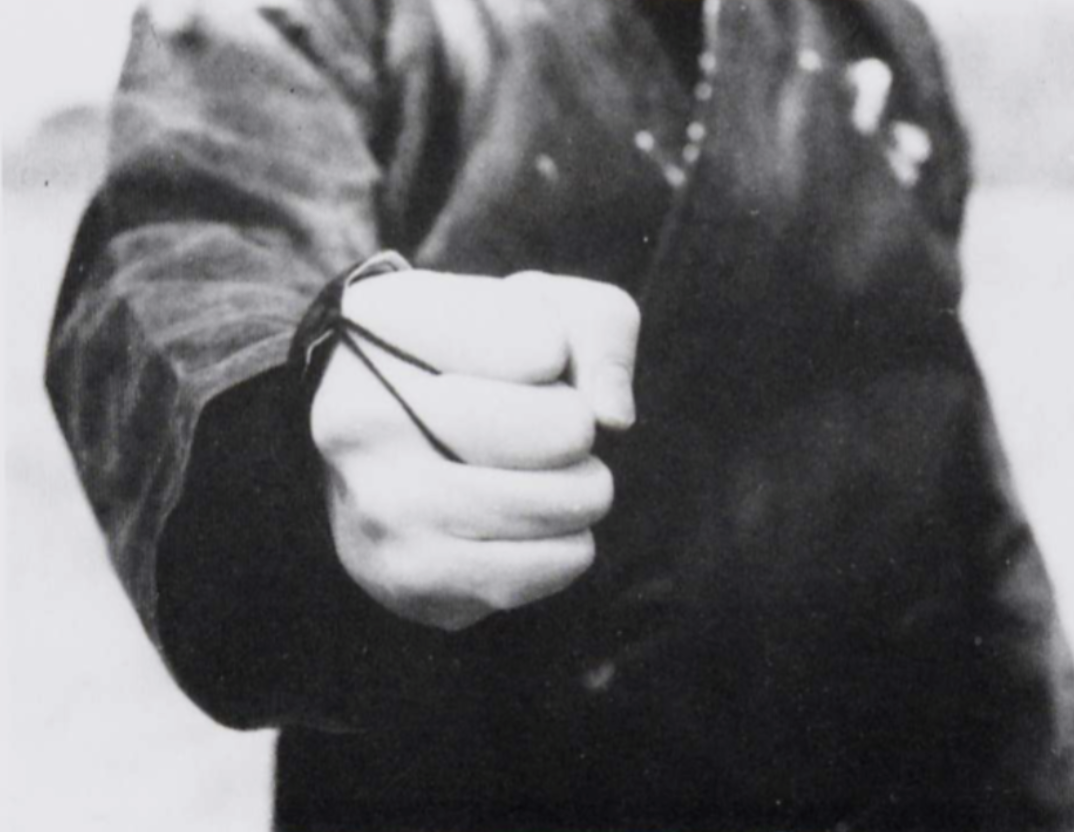
Photo: Masaaki Hatsumi, Togakure, 1983, p. 58.
Level: Kyū
Source: TenChiJin
“Masaaki Hatsumi, TCJ, 1987: 親指外に握りし拳これはやはり多法に用うるものなり。
Translit.: Oyayubi-soto ni nigirishi ken kore wa yahari tahō ni motiuru mono nari.
Masaaki Hatsumi, 1983: 親指外に握りしめた拳。不定打点多変的な拳であり、定型的拳であるように見えるが、どの部分からでも打ち点として使用できる普動拳である。
Translit.: Oyayubi-gai ni nigirishimeta ken. Futei daten ta hen-tekina kendeari, teikei-teki kendearu yōnimieru ga, dono bubun kara demo uchi-ten to shite shiyō dekiru shin dō ken de aru.
”
Translation by Fluffy Tail: It is a fist which is closed with the thumb outside. Well, there are many ways to use it.
The fist is locked outside with a thumb. It is a fist that can be used as an impact point in any way, though it seems to be an “immovable fist”, it is actually a “widely used fist”. [I.e. the usual fist. Play of the words “fudōken” - “shindōken”.]
Commentary by Fluffy Tail: This is usual karate fist, where the big finger blocks and holds the fist together. Contrary to karate, where it is horizontal, in Ninjutsu it is vertical.
The correct striking is extremely complicated and can be described as follows. The aim is to hit the opponent so that he does not see the preparatory movements, thus there pulling back of the arm before strike is minimal, and should be invisible. The power is obtained by the hip work, namely, the hip, the leg on the side of the striking hand move together forwards, while the opposite hip, and corresponding shoulder move backwards. The hip propulses the striking arm and the opponent is pushed away by a whole body weight, enhanced by the speed of moving forwards, and not just by striking with the arm.
The forearm on the strike is to be kept straight to avoid injury.
Strike is directed to virtually any vertical part of the body of the opponent: face, solar plexus, stomach, etc.
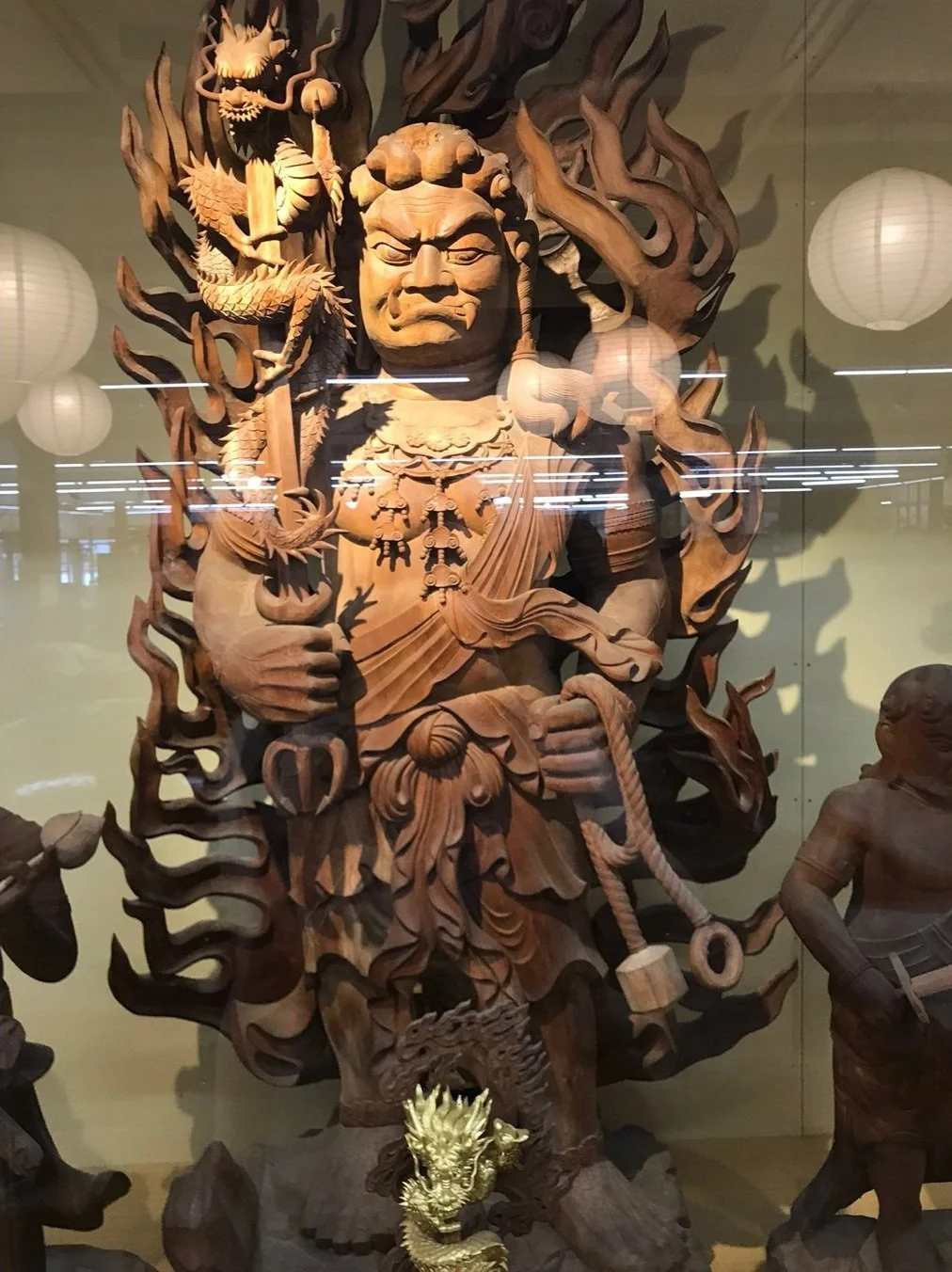
Photo: Fluffy Tail, Miyajima, 2019.
The name and the extreme importance of this strike probably comes from the relation of its name to Fudō-myōō, the “Immovable” Buddhist deity, whose assistance is invoked by various schools of Ninjutsu. He is “immovable” because of his connection to the Buddha Akṣobhya in Sanskrit tradition, but also because he is related to esoteric Buddhism, his symbol is a vajra, variously translated as thunderbolt or diamond, and related to such qualities as being unstoppable, unchangeable and indestructible. The vajra is spelt as kongo in Japanese, and the old name of Fudō ken, a Kongo ken, picks the pieces of this long history together.
Tipps from the Masters :
Arnaud Cousergue: In Gyokko Ryū thumb presses the ring finger, middle and index form thus a sharper shape.
Carsten Kühn, Kukishinden Ryū, p. 18: “Fudō Ken / Kongo Ken (Unbewegliche Faust). Fudō Ken ist die häufigste Fausthaltung im Bujinkan Budō Taijutsu. Die Finger werden eingerollt. Der Daumen light ebenfalls fest an. Die Fauststellung ist senkrecht (Tate). Also in der gleichen Haltung, wie wenn wir einen langen Wanderstab (oder einen Krug) halten. Geschlossen wird die Faust meist erst kurz vor dem Auftreffen.
Beim Kampf in Rüstung findet die geballte Faust fast ausschlisslich als Blocktechnik Anwendung, wobei hier mit den Knöcheln gezielt gegen Muskeln und Nerven, aber auch gegen Gelenke und Knochen, geschlagen wird.“
Carsten Kühn, Ten Ryaku no Maki, p. 107: “Dieser Schlag mit dem Faustrücken nennt sich Shukō Ken.“
Carsten Kühn, Togakure Ryū, p. 19: “In der Togakure Ryū findet die geballte Faust fast ausschlisslich als Blocktechnik Anwendung, wobei hier mit den Knöcheln gezielt gegen Muskeln und Nerven, aber auch gegen Gelenke und Knochen, geschlagen wird.“
Carsten Kühn, Kotō Ryū, p. 19: “Speziell in der Kotō Ryū kommt es darauf an, dem Gegner das Gleichgewicht oder seine Knochen zu brechen. Man versucht, mit möglichst einem einzigen Fauststoss den Angreifer zu besiegen. Dies erfolgt ganz gezielt gegen gelenke und Knochen, aber auch gegen Muskeln und Nerven.“
Carsten Kühn, Takagi Yōshin Ryū, p. 18: “Die Wirkungsweise des geschleuderten, gestossenen oder geworfenen Fudō Ken variiert gerade in der Takagi Yōshin Ryū je nach Situation. Wird Fudō Ken aus kurzer Distanz in einem Haken - also mit angewinkeltem Ellenbogen - geführt, so wird sie auch Ura Tsuki (innerer, oder kurzer Fauststoss) genannt. Trifft der Faustrücken auf, lautet die Bezeichnung Shuko Ken.
Carsten Kühn, Shinden Fudō Ryū, p. 18: “Speziell in der Shinden Fudō Ryū soll der Fudō Ken überwiegend durch das meist mehrmalige, gewaltvolle Auftreffen der Knöchel wirken, welche durch jahreslanges Stossen gegen Bäume oder Steine abgehärtet wurden. Der Gegner soll sich fühlen, als sei er von der Spitze einer Eisenstange getroffen worden.”
Carsten Kühn, Gyokko Ryū, p. 16: “Speziell in der Gyokko Ryū kommt es nicht darauf an, dem Gegner sein Gleichgewicht oder seine Knochen zu brechen. Er soll vielmehr einen “ordentlich“ schmerzhaften Fauststoss abbekommen, jedoch nicht ernsthaft verletzt werden.”